

Products
Equipment Products

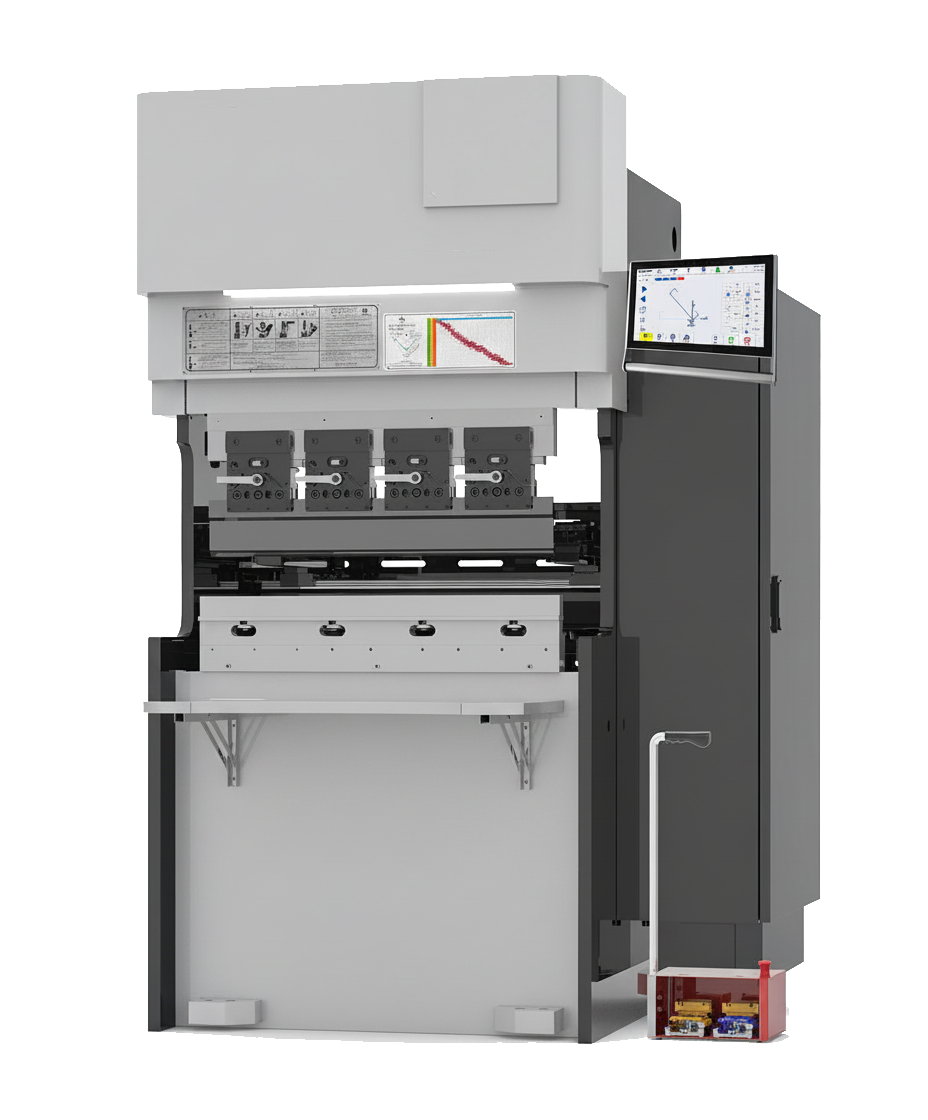
All-Electric Servo Press Brake

Product Features
Equipped with a 12-ton pressing capacity. Y-axis accuracy up to ±0.005 mm; magnetic scale (closed-loop position sensor) with repeatability of ±5 μm, ensuring stable and precise processing.

One-touch leveling and one-touch clamping start functions, complemented by an 18.5-inch large display.

Control system powered by Taiwan Syntec controller, a high-performance CNC system specifically designed for all-electric press brakes.

All-electric servo design features low energy consumption and, compared with hydraulic equipment, offers easier maintenance due to its mechanical structure.
Product Model |  
JBL-EPB1205Series
Equipment Features |  
  • Equipped with a 12-ton pressing capacity. Y-axis accuracy reaches ±0.005 mm, and the magnetic scale (closed-loop position sensor) provides repeatability of ±5 μm, ensuring stable and consistent processing.

  • Features one-touch leveling and one-touch clamping start functions, and is equipped with an 18.5-inch large display.

  • The control system is powered by a Taiwan Syntec controller, a high-performance CNC system specifically designed for all-electric press brakes.

  • The all-electric servo design delivers low energy consumption and, compared with hydraulic equipment, offers easier maintenance due to its simplified mechanical structure.

Equipment Specifications 
  • Pressing Capacity: 12 tons

  • Bending Length: 500 mm

  • Y-Axis Accuracy: ±0.005 mm

  • Number of Axes: 3 axes

  • Motor Power: 6.5 kW

  • Bending Speed: 0.2–50 mm/s

  • Maximum Opening Height: 300 mm

  • Throat Depth: 120 mm

  • Distance Between Side Frames: 420 mm

  • Machine Weight: 1,100 kg

  • Machine Dimensions: 870 × 1100 × 2100 mm


All-Electric Servo
→ Low energy consumption; compared with hydraulic equipment, the structure is easier to maintain.


Low Pollution
→ No hydraulic system required.


A demo machine is available on-site. For inquiries, please contact Chengbo Laser.
Schedule a Machine Viewing
FAQ
Q&A
Q
Will there be smoke or odor during the laser marking process? How is it handled?
A
Some materials may generate a small amount of smoke or odor during laser marking, especially when using a CO₂ laser on materials such as wood or leather. We recommend customers use a dedicated laser fume extractor, which efficiently filters smoke and odors, keeping the workspace clean and maintaining air quality to ensure the health of operators.
A
The price of a laser marking machine varies depending on the laser type, power, configuration, and functions (such as whether it includes an automation system or vision positioning). Prices typically range from several hundred thousand to over one million NTD. Standard configurations usually include the main unit, control software, computer (optional), fixtures (optional), installation, and training. We will provide a detailed quotation based on your specific requirements.
A
The primary difference between laser welding and traditional welding lies in the heat source and energy density. Laser welding offers high energy density, low heat input, fast welding speed, minimal thermal deformation, narrow and deep weld seams, no need for filler material (in certain cases), and the ability to weld difficult-to-weld materials. Traditional welding, on the other hand, often results in a larger heat-affected zone, more noticeable deformation, and slower speed.
A
The choice of laser welding machine power depends on the type of material, thickness, required welding depth, and welding speed. Generally, higher power allows for processing thicker materials, achieving deeper welds, and welding at faster speeds. Common power ranges from several hundred watts to several kilowatts.Jumbo provides testing services and can recommend the most suitable power level based on your specific needs.
A
Our equipment is designed with user-friendliness in mind, featuring an intuitive and simple interface. We provide detailed operation manuals and on-site training, enabling general technicians to operate the machine after instruction. Jumbo also offers fixture design and automation design services to reduce labor requirements.
A

To help you make the best choice, we need to understand your welding requirements in detail, including:

  1. Type and thickness of materials

  2. Desired welding depth and width

  3. Daily or monthly production capacity requirements

  4. Existing production line setup

  5. Specific requirements for welding quality, precision, and efficiency

  6. Budget range

Based on this information, Jumbo professional team will recommend the most suitable equipment and configuration for you.