
Products
Equipment Products

SynFactory

Product Features
Five Core Applications:

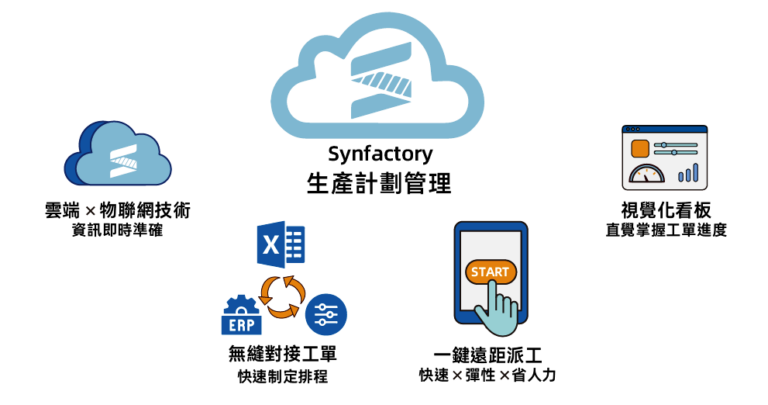
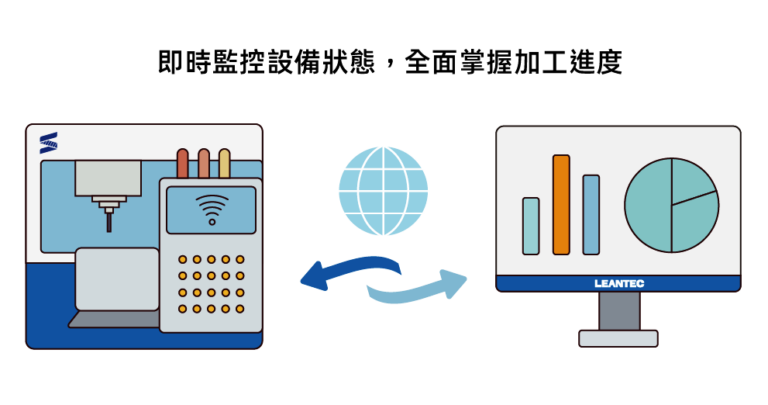
Industrial IoT (IIoT) Applications: Supports networking of equipment from all brands and real-time data subscription.

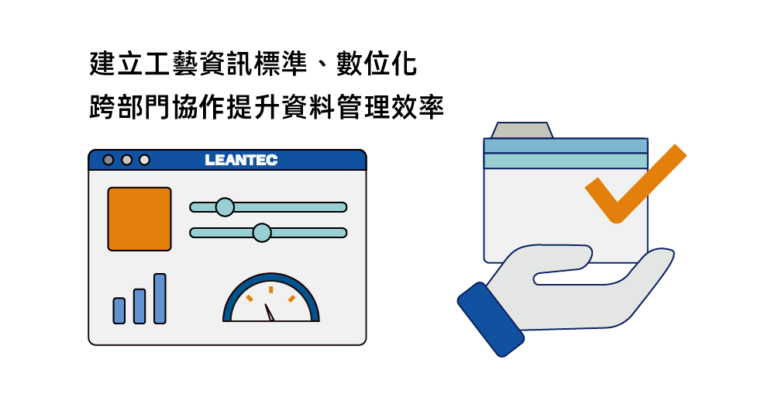
Process Management: Centralized file management and cloud delivery, enabling paperless and fully digital workflows.

Production Management (MES): Real-time tracking of work orders and on-site reporting to monitor order progress.

Management Dashboard: Provides visual analytics of factory-wide output, equipment utilization, and personnel performance.

Green Transformation: Built-in ESG energy monitoring and trend analysis to help enterprises achieve carbon management goals.

Jumbo Laser integrates Syntec Group’s controllers, robots, lasers, and cloud resources to offer rapid deployment solutions—from single machines to entire factory lines—helping clients build highly flexible, low-carbon smart manufacturing systems.
Localized global manufacturing, cost-effective smart production.

SynFactory Smart Manufacturing Cloud

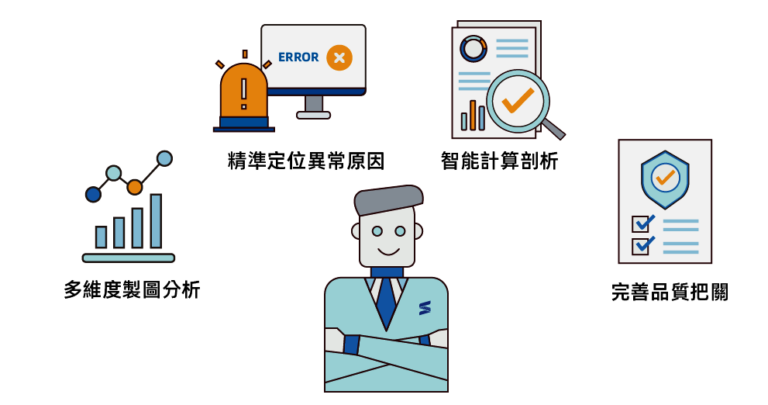
Centered on equipment data, the SynFactory Smart Manufacturing Cloud drives lean factory management, acting as a “factory doctor” to diagnose and resolve complex production management challenges.

“SynFactory is a system designed to control and optimize plant-wide manufacturing processes and serves as the central hub for vertically integrated smart manufacturing. Upstream, it connects with planning and management systems such as ERP, PLM, and WMS; downstream, it links directly to production equipment. It also integrates data across systems, issuing control commands to equipment based on specific scenarios, while equipment status and data are uploaded to the management layer, making it an indispensable component of smart manufacturing.”

As a Factory Manager, Are You Facing These Challenges?


Difficulty Preserving Paper Drawings

Drawings are easily damaged, repeated printing wastes resources, and paper-based files make version control difficult, resulting in disorganized and hard-to-manage process documentation.


Limited Access to Equipment Information

Machine utilization rates are difficult to quantify, capacity usage varies significantly between stations, reducing overall equipment utilization or increasing WIP inventory at the line side.


Difficulty Tracking Production Progress

Manual reporting causes delays, making it impossible to track accurate, real-time production progress and creating challenges for scheduling and order commitments.


Difficulty Preserving Technical Know-How

Experience relies heavily on time and individual judgment, with no standardized SOPs, making knowledge and technical expertise difficult to transfer and retain.

Core Advantages

Built on an Industrial IoT foundation, this factory management platform integrates multiple system modules into a unified architecture spanning the equipment layer, data acquisition layer, and application layer to meet diverse factory management needs.

User-Friendly

Intuitive interfaces and workflows are tailored to different usage scenarios. The system supports multiple devices, including PCs, smartphones, and tablets, enabling smart factory management anytime, anywhere.

Lightweight & Flexible

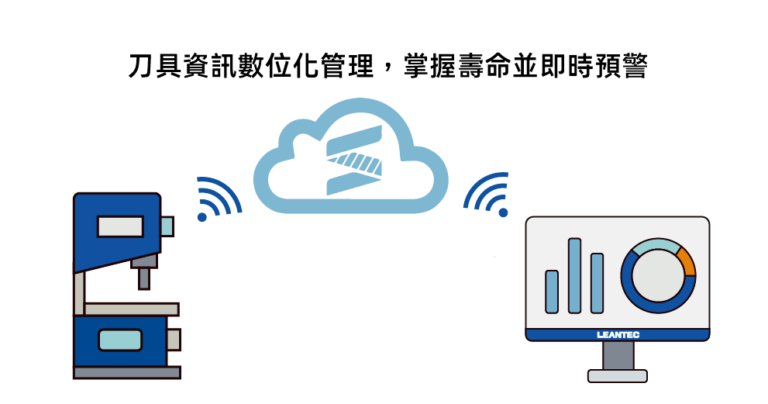
Modular system design allows flexible selection of functional modules to easily build a customized smart factory. Modules include equipment, process, production, tool, quality, and inventory management.

Highly Integrated

From equipment data acquisition and standardized process data to real-time shop-floor reporting, all modules are integrated from edge to cloud, making smart manufacturing as easy as assembling building blocks.

Open Architecture

An open database enables access to key data for custom dashboards and analytical reports, supporting secondary development. It also connects seamlessly with existing ERP, PLM, and MES systems via API or ETL.

Management Solutions & Key Features

Main Modules: IIoT Connectivity, Equipment Management, Process Management, Production Management, Quality Traceability, Tool Life Management, Inventory Management

Phased Implementation for Easy Smart Manufacturing Adoption

50%

IIoT Deployment

Edge-to-cloud integration with data visualization

80%

Partial Digital Transformation

Targeted solutions with immediate results

100%

Smart Factory Realization

Plant-wide deployment with optimized workflows

A demo machine is available on-site. For inquiries, please contact Chengbo Laser.
Schedule a Machine Viewing
FAQ
Q&A
Q
Will there be smoke or odor during the laser marking process? How is it handled?
A
Some materials may generate a small amount of smoke or odor during laser marking, especially when using a CO₂ laser on materials such as wood or leather. We recommend customers use a dedicated laser fume extractor, which efficiently filters smoke and odors, keeping the workspace clean and maintaining air quality to ensure the health of operators.
A
The price of a laser marking machine varies depending on the laser type, power, configuration, and functions (such as whether it includes an automation system or vision positioning). Prices typically range from several hundred thousand to over one million NTD. Standard configurations usually include the main unit, control software, computer (optional), fixtures (optional), installation, and training. We will provide a detailed quotation based on your specific requirements.
A
The primary difference between laser welding and traditional welding lies in the heat source and energy density. Laser welding offers high energy density, low heat input, fast welding speed, minimal thermal deformation, narrow and deep weld seams, no need for filler material (in certain cases), and the ability to weld difficult-to-weld materials. Traditional welding, on the other hand, often results in a larger heat-affected zone, more noticeable deformation, and slower speed.
A
The choice of laser welding machine power depends on the type of material, thickness, required welding depth, and welding speed. Generally, higher power allows for processing thicker materials, achieving deeper welds, and welding at faster speeds. Common power ranges from several hundred watts to several kilowatts.Jumbo provides testing services and can recommend the most suitable power level based on your specific needs.
A
Our equipment is designed with user-friendliness in mind, featuring an intuitive and simple interface. We provide detailed operation manuals and on-site training, enabling general technicians to operate the machine after instruction. Jumbo also offers fixture design and automation design services to reduce labor requirements.
A

To help you make the best choice, we need to understand your welding requirements in detail, including:

  1. Type and thickness of materials

  2. Desired welding depth and width

  3. Daily or monthly production capacity requirements

  4. Existing production line setup

  5. Specific requirements for welding quality, precision, and efficiency

  6. Budget range

Based on this information, Jumbo professional team will recommend the most suitable equipment and configuration for you.